ASTER and Flexible Rectification for Camera-Captured Formulas
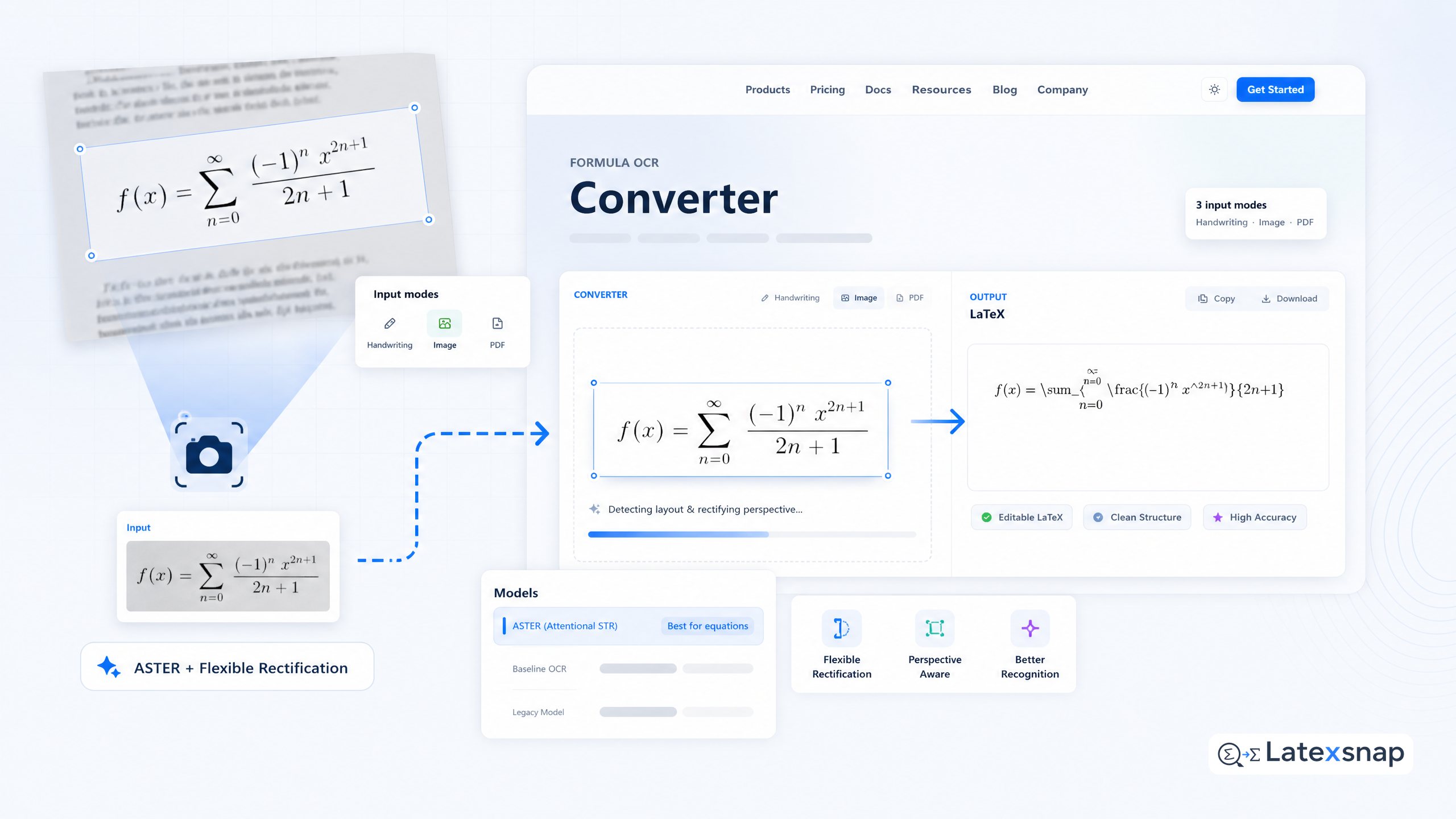
ASTER (Attentional Scene Text Recognizer with Flexible Rectification) is a model that improves how equation images are recognized when they are captured from real-world sources like phone photos, screenshots, or PDFs. The paper introduces a flexible rectification method that adjusts for perspective distortion, making it easier for OCR systems to read formulas that are not perfectly aligned or straight.
LatexSnap uses advanced OCR models to convert equation images into editable LaTeX. When working with camera-captured formulas, flexible rectification helps reduce errors caused by perspective distortion, ensuring more accurate transcription.
The Problem with Camera-Captured Equations
Equation images captured from real-world sources often suffer from perspective distortion. This happens when the camera angle is not perfectly aligned with the formula, causing lines to appear slanted or uneven. Traditional OCR models struggle with these distortions, leading to recognition errors. A useful companion workflow is CTC and the Problem of Reading Unsegmented Formula Images, especially when CTC formula OCR becomes part of the review process.
For example, a formula that appears straight in a textbook may look skewed in a photo. This distortion can cause OCR systems to misinterpret symbols, miss parts of equations, or fail to recognize the entire formula.
LatexSnap addresses this challenge by using flexible rectification techniques that adjust for perspective distortion. This ensures that even skewed or distorted formulas are transcribed accurately.
How ASTER Works
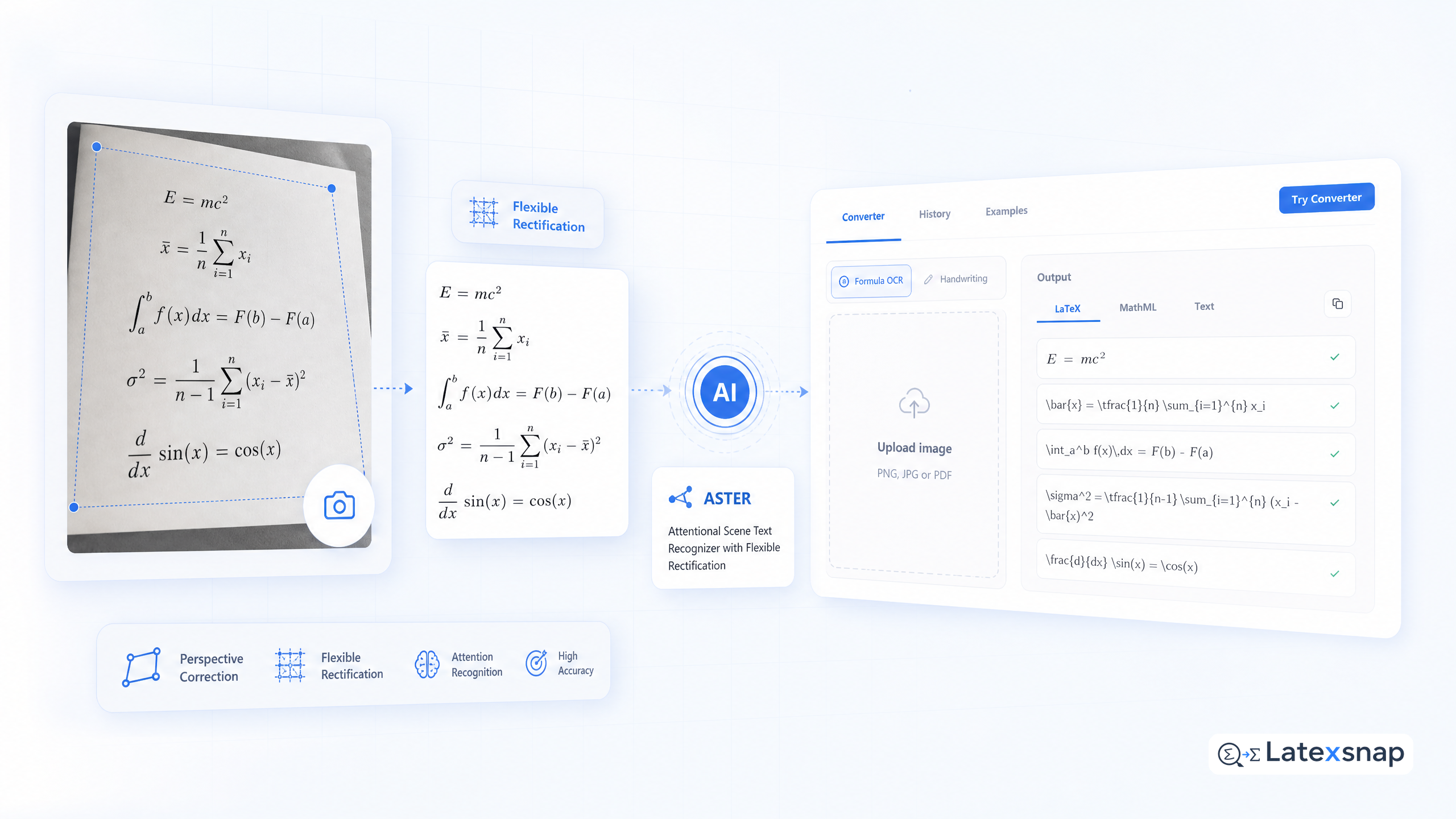
ASTER combines two key components: an attentional scene text recognizer and a flexible rectification module. The attentional recognizer focuses on relevant parts of the image while ignoring distractions. The flexible rectification module adjusts the image to correct perspective distortion before recognition. For a related next step on equation image rectification, see RARE and Automatic Rectification for Crooked Equation Screenshots.
This two-step process improves the accuracy of equation recognition, especially for camera-captured formulas. By rectifying the image first, ASTER ensures that the OCR model receives a clearer and more accurate representation of the formula. If you want to compare this with another practical angle, CRNN Lessons for Turning Image Features into LaTeX Tokens covers CRNN formula OCR in more detail.
LatexSnap leverages similar principles to enhance its OCR capabilities. By applying flexible rectification, LatexSnap can handle a wider range of equation images, from textbook scans to phone photos.
Practical Benefits for Equation OCR
Flexible rectification has several practical benefits for equation OCR workflows. First, it improves recognition accuracy by correcting perspective distortion. Second, it reduces the need for manual adjustments, saving time and effort. Third, it enables OCR systems to handle a wider range of equation images, from textbook scans to phone photos.
For example, a formula captured from a phone photo may appear skewed due to the camera angle. Without flexible rectification, the OCR system may struggle to recognize the formula accurately. With flexible rectification, the image is adjusted to correct the distortion, allowing the OCR system to transcribe the formula correctly. For teams extending this workflow, MDRNN and Why Two-Dimensional Context Matters in Formula OCR is a natural follow-up for two-dimensional OCR context.
LatexSnap uses flexible rectification to improve its OCR capabilities. This ensures that even skewed or distorted formulas are transcribed accurately, making it easier for users to work with equation images from various sources.
Tips for Capturing High-Quality Equation Images
To get the best results from equation OCR, it's important to capture high-quality images. Here are some tips for capturing equation images: When the document pipeline gets more complex, DBNet and Cleaner Equation Masks for Faster Formula Capture gives more context on equation mask detection.
- Use good lighting to ensure the formula is clearly visible.
- Hold the camera steady to avoid blurring or distortion.
- Capture the formula from a straight-on angle to minimize perspective distortion.
- Avoid capturing formulas from too far away or too close up.
LatexSnap can handle a wide range of equation images, but capturing high-quality images will improve the accuracy of the transcription. By following these tips, users can ensure that their equation images are captured correctly and transcribed accurately.
Reviewing and Editing Transcribed Formulas
Even with advanced OCR models, it's important to review and edit transcribed formulas. OCR systems may make errors, especially with complex or ambiguous symbols. By reviewing the transcribed formulas, users can catch and correct any errors.
LatexSnap provides a user-friendly interface for reviewing and editing transcribed formulas. Users can easily make changes to the LaTeX code, ensuring that the final output is accurate and error-free.
Conclusion
ASTER and flexible rectification are important advancements in equation OCR. By correcting perspective distortion, these techniques improve the accuracy of equation recognition, especially for camera-captured formulas. LatexSnap leverages similar principles to enhance its OCR capabilities, ensuring that even skewed or distorted formulas are transcribed accurately.
By following best practices for capturing equation images and reviewing transcribed formulas, users can ensure that their equation images are captured correctly and transcribed accurately. With the right tools and techniques, working with equation images becomes easier and more efficient.
Convert formulas faster
Turn screenshots, handwriting, and PDFs into editable LaTeX.
