MDRNN and Why Two-Dimensional Context Matters in Formula OCR

Introduction
In formula OCR, the challenge isn't just recognizing individual symbols-it's understanding how they relate across both horizontal and vertical dimensions. A superscript, a fraction bar, or a nested brace requires the system to read not just left-to-right, but also up-and-down. This is where multi-dimensional context becomes critical. For a related next step on CTC formula OCR, see CTC and the Problem of Reading Unsegmented Formula Images.
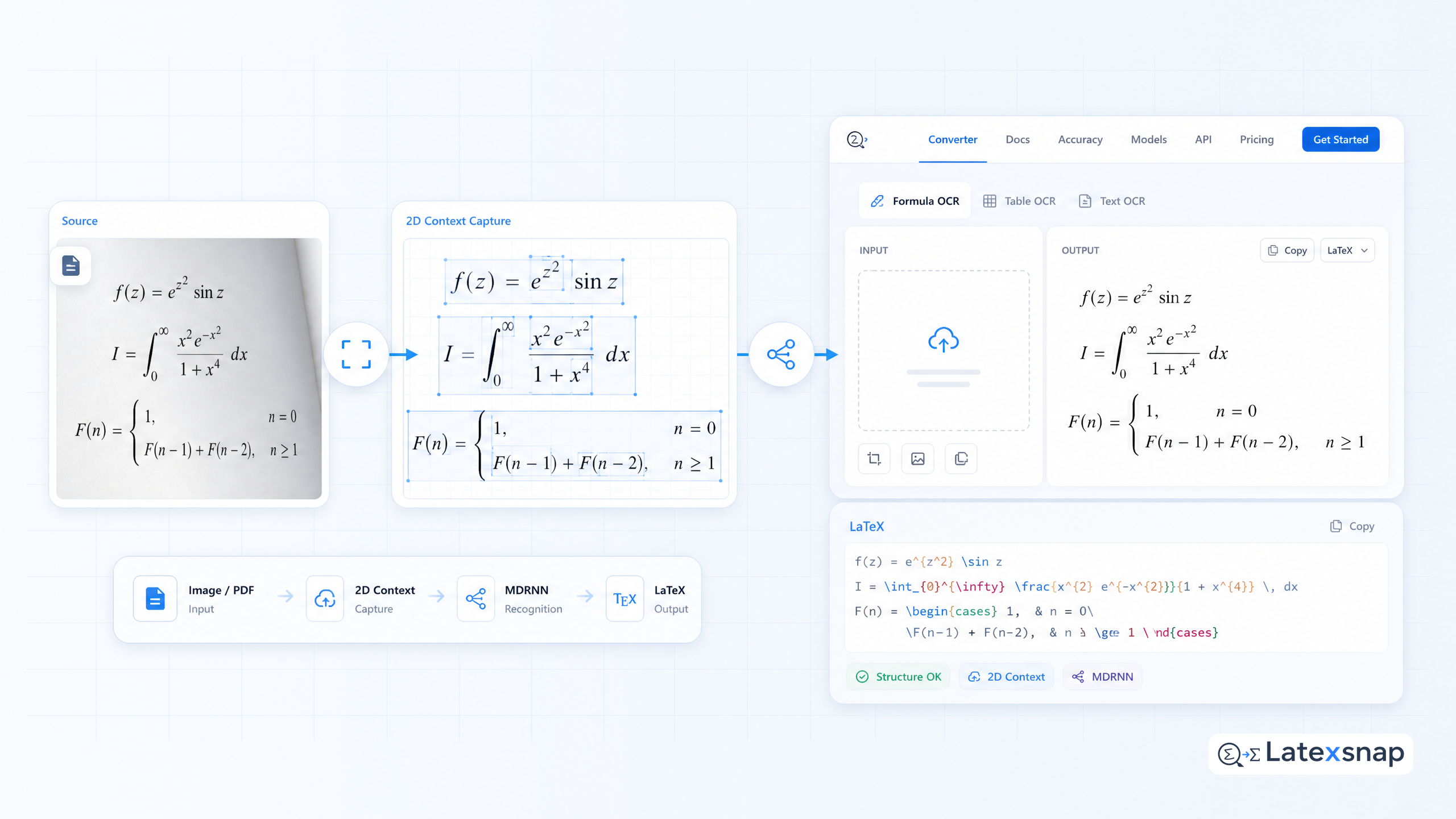
LatexSnap leverages advanced OCR models that process formulas as two-dimensional structures, not just linear strings of characters. This approach significantly improves accuracy when handling complex mathematical layouts, especially in academic papers, textbooks, and technical documents.
The Problem with One-Dimensional OCR
Traditional OCR engines treat text as a sequence of characters read from left to right. This works well for prose but breaks down with math. Consider a fraction like:
$$ frac{a}{b} $$
A one-dimensional model might misinterpret the layout, treating the numerator and denominator as separate lines rather than a single unit. Similarly, superscripts and subscripts can be misaligned or omitted entirely.
This limitation is especially problematic in dense mathematical expressions where symbols are tightly packed and context-dependent. Without two-dimensional awareness, even high-resolution scans can yield incorrect LaTeX output.
How Multi-Dimensional Models Work
Multi-dimensional recurrent neural networks (MD-RNNs) address this by modeling relationships across both axes. Instead of processing each character in isolation, these models analyze local neighborhoods-capturing how a symbol's meaning depends on its neighbors above, below, and beside it.
For example, in the expression:
$$ sqrt{x^2 + y^2} $$
The square root symbol spans multiple lines. An MD-RNN recognizes this structure by analyzing the vertical alignment and bounding box relationships between components. This allows for more accurate transcription of nested radicals, integrals, and other multi-line constructs.
LatexSnap uses similar principles to ensure that even complex equations are parsed with structural fidelity, preserving the intended LaTeX hierarchy.
Practical Impact on Formula OCR
The shift to multi-dimensional processing has tangible benefits:
- Improved handling of fractions and radicals: Symbols that span multiple lines are now recognized as unified structures.
- Better alignment of superscripts and subscripts: Contextual cues help distinguish between inline exponents and standalone annotations.
- Enhanced robustness to formatting variations: Whether the formula is rendered in MathJax, LaTeX, or plain text, the model adapts to preserve meaning.
These improvements are especially valuable for researchers converting legacy documents, educators digitizing textbooks, and developers building document AI pipelines. If you want to compare this with another practical angle, RARE and Automatic Rectification for Crooked Equation Screenshots covers equation image rectification in more detail.
Reviewing OCR Output: A Practical Guide
Even with advanced models, manual review remains essential. Here's how to ensure high-quality LaTeX output:
1. Check Crop Quality
Low-resolution or skewed crops can confuse OCR engines. Ensure that:
- All symbols are fully visible and not cut off at the edges.
- There is sufficient contrast between text and background.
- No extraneous artifacts (e.g., watermarks, shadows) interfere with symbol recognition.
2. Verify Symbol Ambiguities
Some symbols look similar in isolation but differ in context:
- $int$ vs. $exists$
- $partial$ vs. $d$
- $sum$ vs. $pi$
Reviewers should cross-check these against the original source, especially in dense expressions.
3. Validate LaTeX Structure
Ensure that:
- Brackets and braces are properly nested.
- Operators like $frac{}{}$, $sqrt{}$, and $sum$ are correctly formatted.
- Subscripts and superscripts are aligned with their base characters.
4. Perform a Final Read-Through
After automated conversion, always do a quick visual pass. Look for:
- Missing or duplicated symbols.
- Misplaced accents or diacritics.
- Inconsistent spacing or alignment.
LatexSnap's output is designed to be editable and review-friendly, making this step efficient and effective. For teams extending this workflow, CTPN and the First Step: Finding Equation Regions Before OCR is a natural follow-up for equation region detection.
Conclusion
Two-dimensional context is no longer optional in high-stakes formula OCR. As mathematical content becomes increasingly digitized, the ability to interpret formulas as structured, spatial entities is essential. Models like MD-RNNs provide the foundation for this capability, enabling systems to handle the complexity of real-world equations with greater accuracy. When the document pipeline gets more complex, Writing LaTeX Math Equations with AI gives more context on formula OCR workflow.
For teams evaluating OCR tools, the key takeaway is clear: look beyond character-level recognition. True formula fidelity requires models that understand the geometry of math-and LatexSnap is built with that insight at its core. A useful companion workflow is CRNN Lessons for Turning Image Features into LaTeX Tokens, especially when CRNN formula OCR becomes part of the review process.
Convert formulas faster
Turn screenshots, handwriting, and PDFs into editable LaTeX.
