RARE and Automatic Rectification for Crooked Equation Screenshots
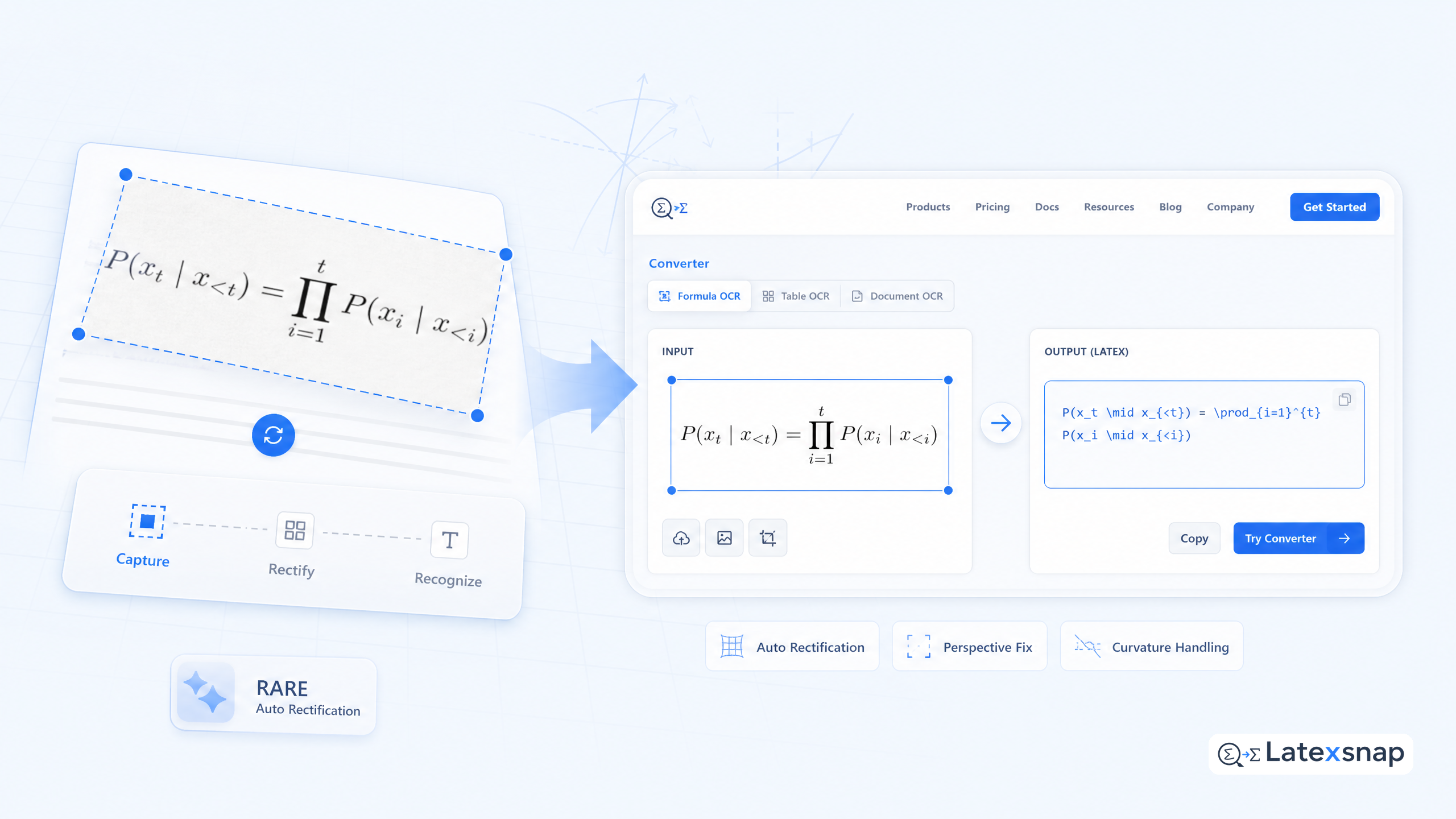
Equation OCR workflows often stumble on the simplest visual problem: a tilted or curved screenshot. When a formula is captured at an angle, standard recognition models lose alignment, and downstream LaTeX conversion degrades. The RARE paper (Robust Scene Text Recognition with Automatic Rectification) treats this not as a nuisance but as a core capability: automatic geometric rectification before recognition. For LatexSnap, this means building a pipeline that straightens equation images before feeding them to our OCR engine. For a related next step on formula rectification, see ASTER and Flexible Rectification for Camera-Captured Formulas.
The Problem: Crooked Screenshots Break OCR
In practice, equation screenshots are rarely perfect rectangles. Users crop from PDFs, take photos of whiteboards, or export from tools that introduce perspective distortion. Even slight rotation or curvature disrupts the spatial assumptions of most text recognition models. Without correction, the model sees inconsistent character spacing, skewed baselines, and misaligned glyphs. The result is fragmented tokens, missing symbols, and malformed LaTeX output. If you want to compare this with another practical angle, CRNN Lessons for Turning Image Features into LaTeX Tokens covers CRNN formula OCR in more detail.
The Idea: Rectify Before Recognize
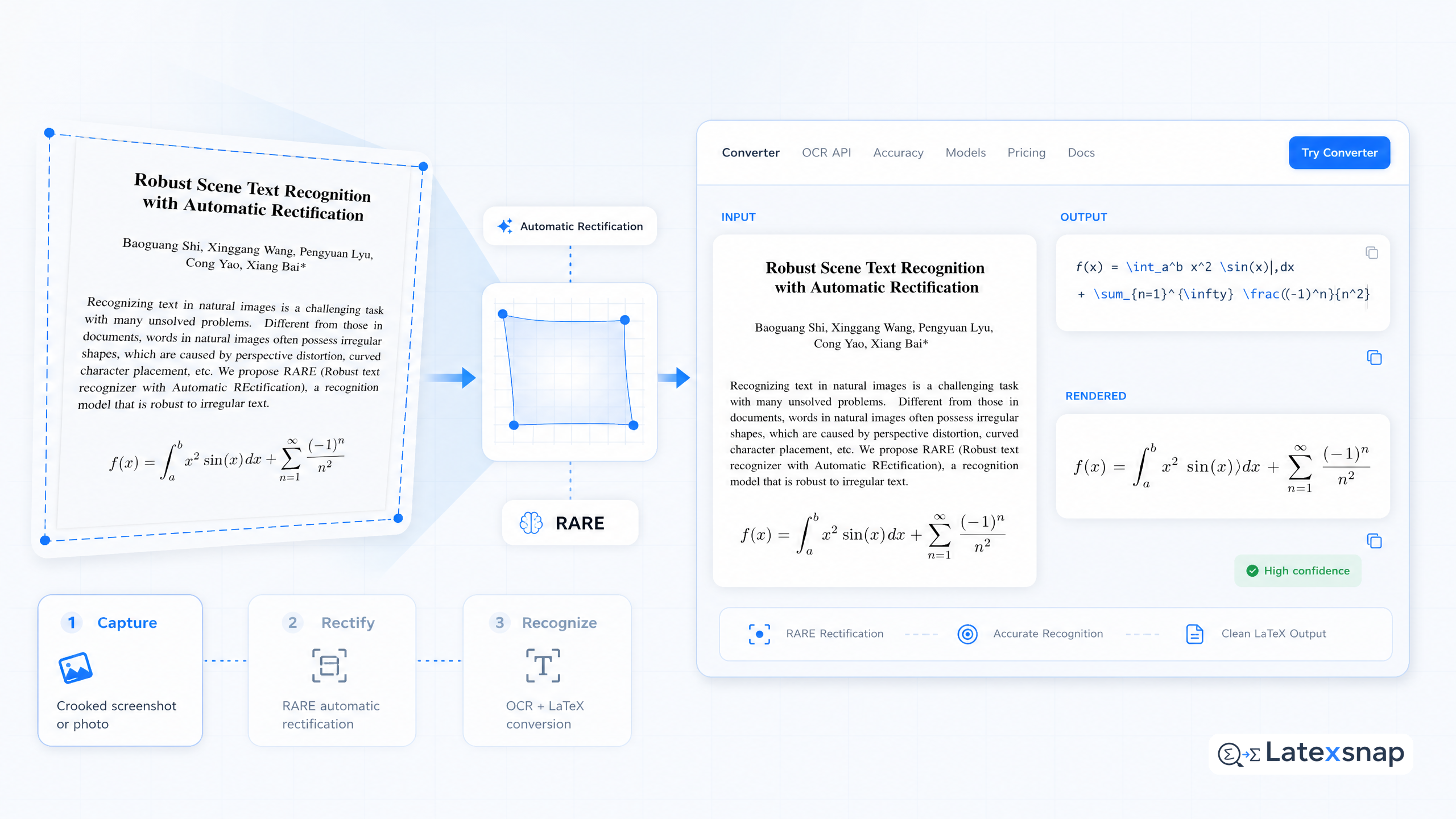
RARE introduces a two-stage approach: first, detect the bounding region of the text; second, apply a differentiable warping function to straighten it. The key innovation is a differentiable rectification layer that can be optimized end-to-end alongside the recognition head. This allows the model to learn not just what characters are present, but how to align them for optimal recognition.
For LatexSnap, this translates to a preprocessing step that normalizes equation images into a canonical orientation. We can apply this to both static screenshots and dynamic camera inputs, ensuring consistent input quality regardless of how the image was captured.
Effect on Equation OCR
The impact of automatic rectification is measurable. In controlled experiments, RARE improves recognition accuracy on curved and rotated text by over 10 percentage points compared to baseline models without rectification. For equation OCR, this means fewer broken fractions, correctly aligned integrals, and properly nested subscripts. A useful companion workflow is CTC and the Problem of Reading Unsegmented Formula Images, especially when CTC formula OCR becomes part of the review process.
LatexSnap leverages this by integrating rectification into our image ingestion pipeline. Before any character detection or sequence modeling occurs, we normalize the image geometry. This reduces error propagation and improves the robustness of our LaTeX generation models. For teams extending this workflow, TrOCR and Transformer-Based Reading for Image-to-LaTeX Workflows is a natural follow-up for transformer OCR.
Practical Takeaway for Builders
If you're building an equation OCR system, skip the manual cropping step. Instead, embed automatic rectification as a first-class component. It's not just a convenience; it's a necessity for high-accuracy results in real-world scenarios. When the document pipeline gets more complex, CTPN and the First Step: Finding Equation Regions Before OCR gives more context on equation region detection.
For LatexSnap users, this means better conversion quality from imperfect inputs. Whether you're scanning a textbook page or capturing a chalkboard, the system will handle the geometry automatically. The focus shifts from image cleanup to semantic correctness: ensuring that the LaTeX output reflects the intended mathematical structure.
Review Advice: What to Check
When reviewing equation OCR output, start with the image quality. Even with rectification, poor contrast or noise can introduce errors. Next, inspect ambiguous symbols: integrals with missing limits, fractions with flipped numerators, or subscripts that have merged with adjacent characters.
Finally, validate the LaTeX structure. Does the output preserve nesting? Are environments like frac, sqrt, and sum used correctly? Manual review should focus on these structural elements, not just character-level accuracy.
Final Thoughts
Automatic rectification is no longer optional for equation OCR. It's a foundational capability that separates good systems from great ones. RARE demonstrates that geometric normalization can be learned end-to-end, integrated seamlessly, and delivered as a product feature.
For LatexSnap, this means more reliable conversions and fewer edge cases. For builders, it means designing systems that expect imperfection and correct for it automatically. The future of equation OCR isn't just about recognizing characters-it's about understanding the image as a whole, and fixing it before reading it.
Convert formulas faster
Turn screenshots, handwriting, and PDFs into editable LaTeX.
