What New Document OCR Models Mean for Equation and PDF Conversion
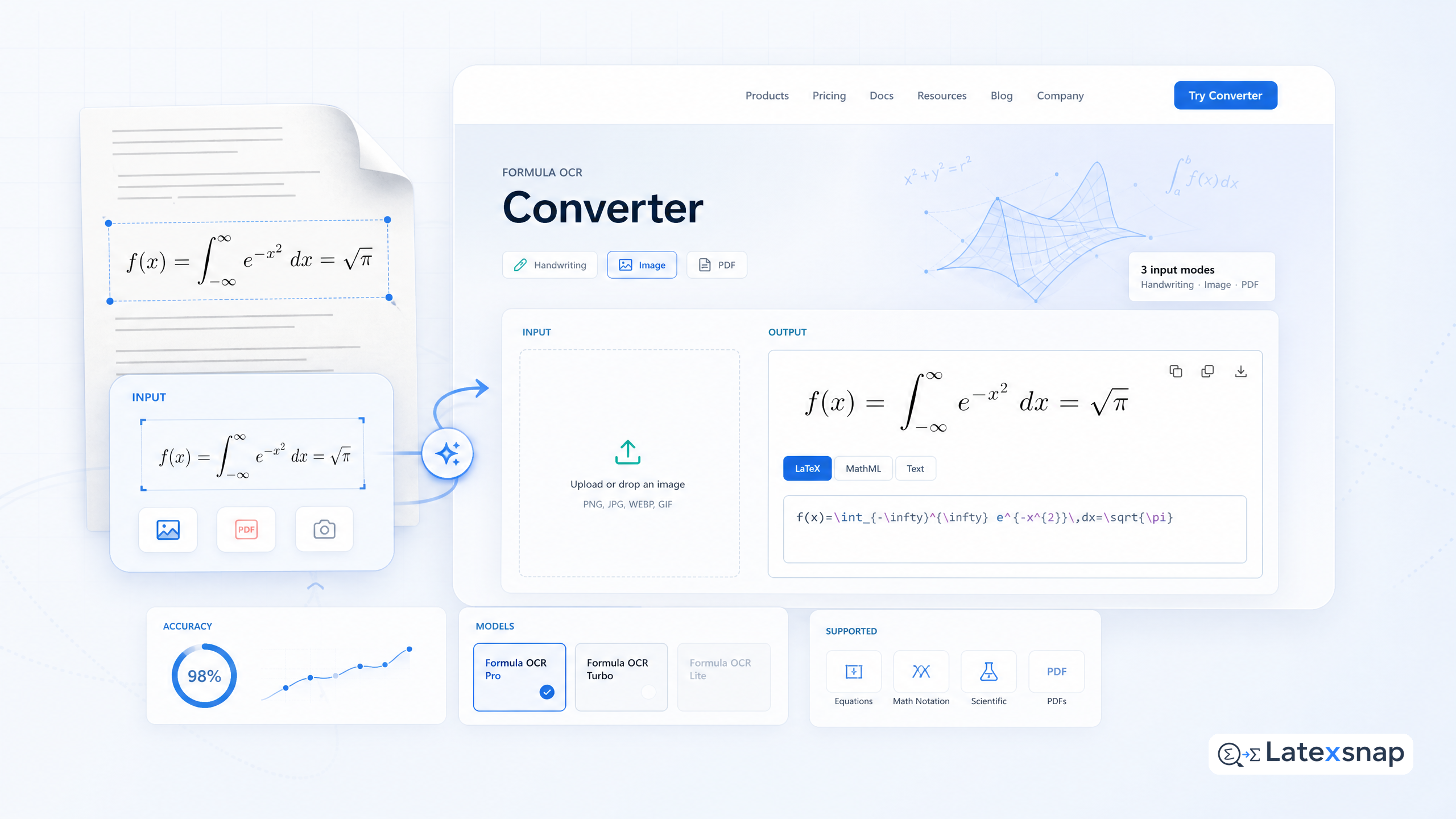
Equation OCR has become an essential tool for students, researchers, and technical writers who work with mathematical formulas and scientific notation. Whether you're converting handwritten equations, scanning textbook pages, or extracting formulas from PDFs, accurate OCR is key to preserving the integrity of your work.
With the latest advancements in document OCR technology, the accuracy and efficiency of equation recognition have improved dramatically. These updates are not just incremental-they represent a significant leap forward in how we process and convert complex mathematical content.
Why Equation OCR Matters
Equation OCR is more than just a convenience-it's a necessity for anyone working with technical content. From academic papers to engineering schematics, equations are often the backbone of the information being conveyed. Traditional OCR tools often struggle with mathematical symbols, leading to errors that can compromise the accuracy of the final document.
New document OCR models are designed to tackle these challenges head-on. They use advanced algorithms and deep learning techniques to recognize and convert equations with unprecedented precision. This means fewer errors, faster conversion times, and a smoother workflow for professionals who rely on accurate equation processing. For a related next step on document OCR workflow, see PDF to Word Conversion for Equation OCR.
The Impact of New Document OCR Models
The latest document OCR models are built on cutting-edge technology that significantly improves equation recognition. These models are trained on vast datasets of mathematical equations, allowing them to understand and convert complex formulas with greater accuracy than ever before.
One of the most notable improvements is the ability to handle a wider range of equation styles and formats. Whether you're working with inline equations, displayed formulas, or even handwritten math, these new models can process them with minimal errors. This versatility makes them an invaluable tool for anyone dealing with diverse equation formats.
How Document OCR Enhances PDF Conversion
PDFs are a staple in academic and professional settings, but extracting equations from them can be a tedious and error-prone process. New document OCR models have revolutionized this workflow by making PDF-to-LaTeX conversion faster and more reliable. A useful companion workflow is Image to LaTeX workflow, especially when formula OCR workflow becomes part of the review process.
With these advanced models, you can now convert PDFs containing equations into editable LaTeX documents with just a few clicks. This not only saves time but also ensures that the equations remain accurate and properly formatted. For researchers and students, this means less time spent manually correcting equations and more time focused on their actual work.
Practical Tips for Using Equation OCR
To get the most out of equation OCR, it's important to follow a few best practices. First, ensure that the images or PDFs you're converting are of high quality. Blurry or low-resolution images can lead to errors in equation recognition.
Another tip is to use tools that allow you to preview the converted equations before finalizing them. This helps catch any discrepancies early on and ensures that the final document is accurate. Additionally, familiarize yourself with the common pitfalls of equation OCR, such as misinterpreted symbols or formatting issues, so you can address them proactively. When the document pipeline gets more complex, Nougat and Academic Paper OCR for Equation-Heavy Documents gives more context on academic paper OCR.
The Future of Equation and PDF Conversion
As document OCR technology continues to evolve, we can expect even greater improvements in equation recognition and PDF conversion. Future models will likely be even more accurate, faster, and capable of handling an even wider range of equation styles. For teams extending this workflow, TrOCR and Transformer-Based Reading for Image-to-LaTeX Workflows is a natural follow-up for transformer OCR.
For now, the latest document OCR models already offer a significant advantage for anyone working with equations and PDFs. By leveraging these tools, you can streamline your workflow, reduce errors, and focus on what really matters-your work. If you want to compare this with another practical angle, How to Write Fractions in LaTeX covers LaTeX editing workflow in more detail.
If you're looking to enhance your equation and PDF conversion process, now is the time to explore the latest document OCR models. With their advanced capabilities and user-friendly interfaces, they're poised to become an indispensable part of your technical toolkit.
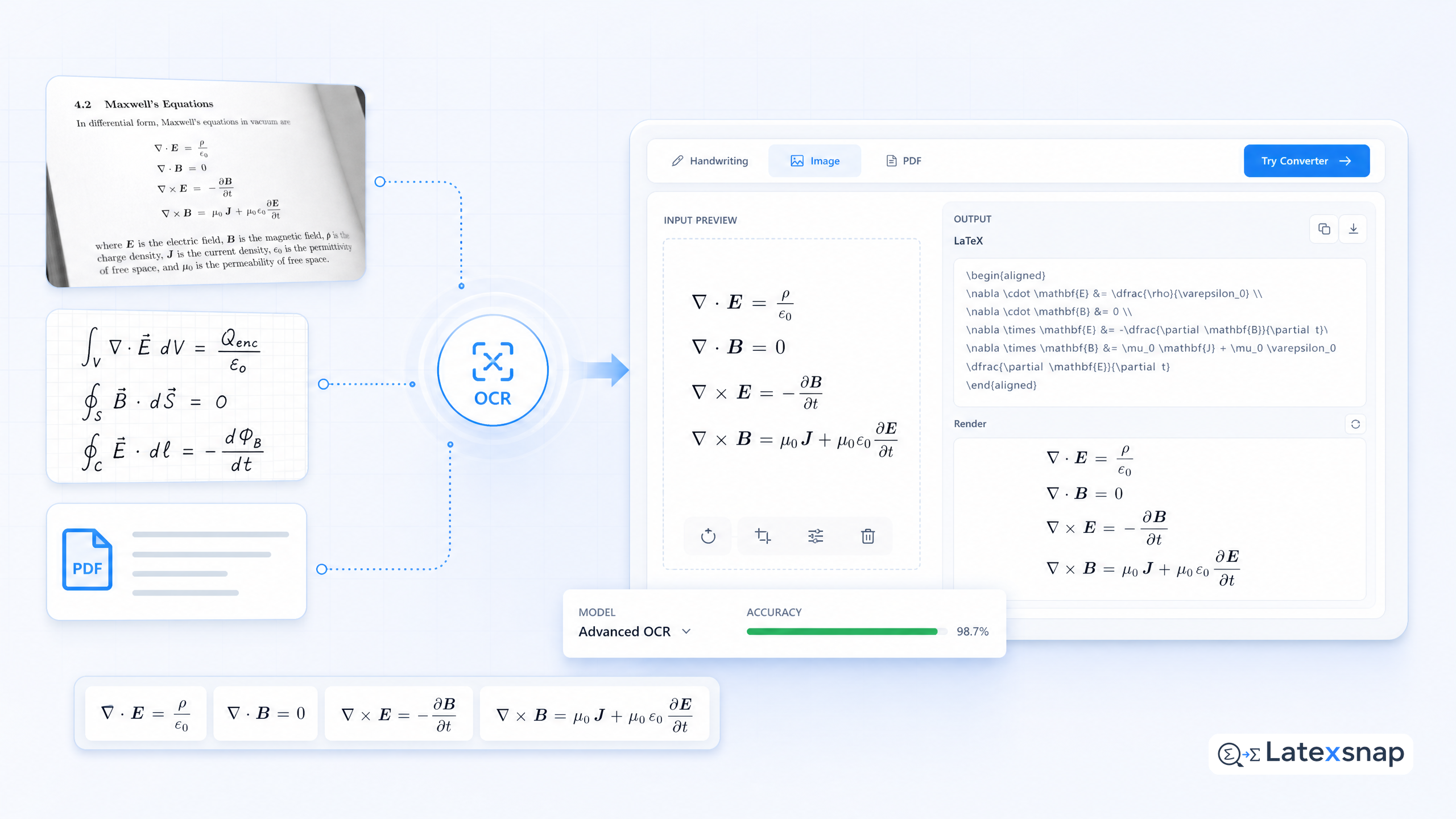
Convert formulas faster
Turn screenshots, handwriting, and PDFs into editable LaTeX.
