Nougat and Academic Paper OCR for Equation-Heavy Documents
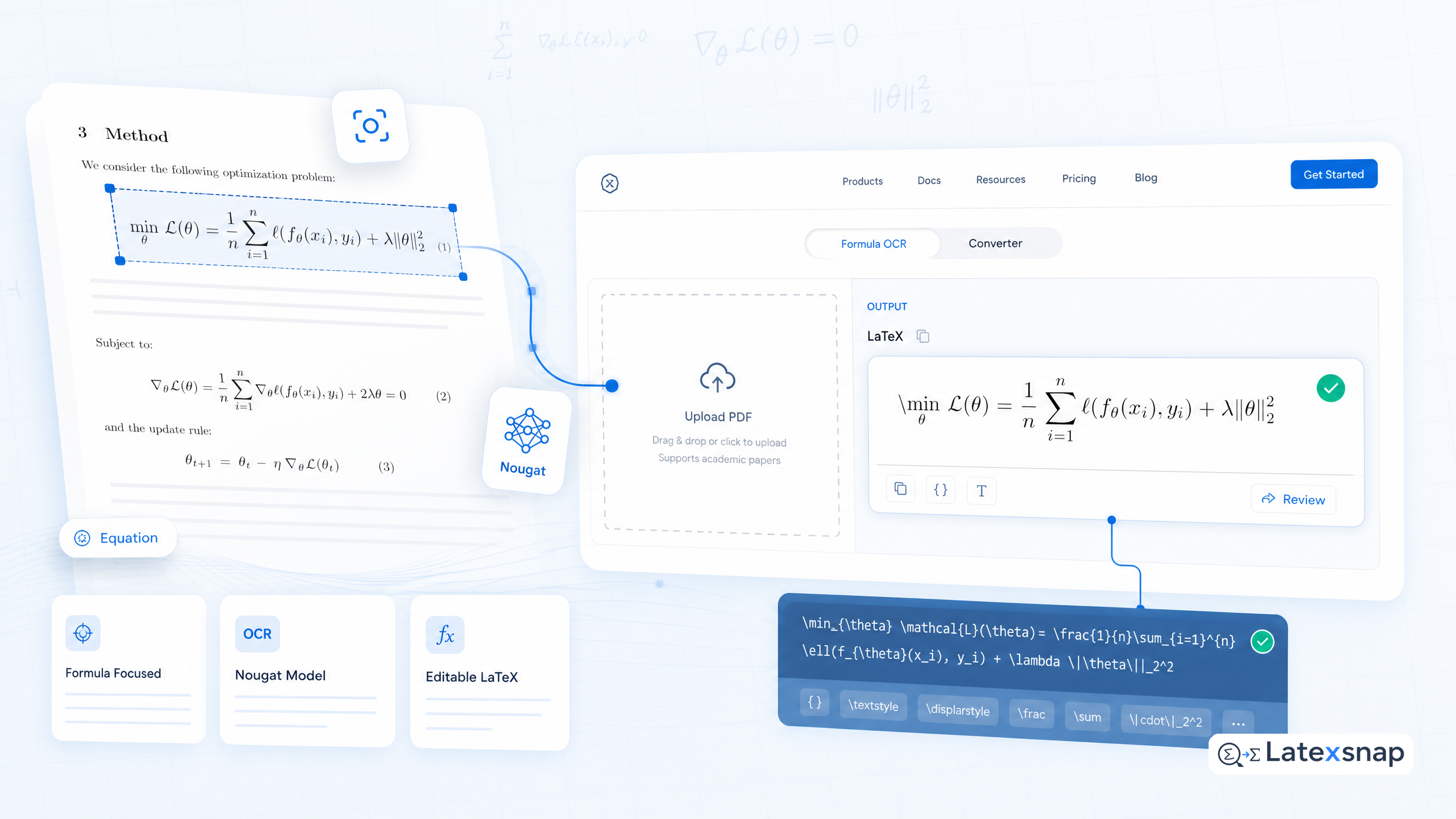
Nougat is a new model for OCR of academic papers, with a focus on formulas. It's an interesting development for LatexSnap, which also focuses on OCR of formulas in academic papers.
This post explains the model/paper as a product capability: problem, idea, effect on equation OCR, and practical LatexSnap takeaway.
Problem
Academic papers are full of formulas. They're usually in PDF format, and PDFs are notoriously difficult to convert to editable text.
Existing OCR engines, such as Tesseract OCR, excel at detecting and classifying individual characters and words in an image, but fail to understand the relationship between them due to their line-by-line approach. This means that they treat superscripts and subscripts in the same way as the surrounding text, which is a significant limitation for academic papers. For a related next step on CRNN formula OCR, see CRNN Lessons for Turning Image Features into LaTeX Tokens.
Idea
Nougat is a new model for OCR of academic papers, with a focus on formulas. It's based on a transformer architecture, which is a type of neural network that's particularly good at understanding the relationship between words in a sentence.
Nougat is trained on a large dataset of academic papers, which includes both the text and the corresponding LaTeX code. This allows the model to learn the relationship between the two, and to generate LaTeX code that's accurate and well-formatted.
Effect on Equation OCR
Nougat is a significant improvement over existing OCR engines for academic papers. It's able to accurately convert formulas to LaTeX code, which is a major advantage for researchers and technical writers.
Nougat is also able to handle a wide range of formula types, including inline formulas, displayed formulas, and equations with multiple lines. This makes it a versatile tool for a wide range of applications. If you want to compare this with another practical angle, Image to LaTeX workflow covers formula OCR workflow in more detail.
Practical LatexSnap Takeaway
LatexSnap is a tool for converting equation images, handwriting, screenshots, and PDF formula snippets into editable LaTeX. It's a powerful tool for researchers and technical writers who need to work with formulas in their documents. A useful companion workflow is LaTeX Editor Tips for Equation-Heavy Writing, especially when LatexSnap workflow becomes part of the review process.
Nougat is a new model for OCR of academic papers, with a focus on formulas. It's an interesting development for LatexSnap, which also focuses on OCR of formulas in academic papers. For teams extending this workflow, LaTeX vs word processors: Which Is Better for Academic Writing? is a natural follow-up for LaTeX editing workflow.
LatexSnap can be used to convert Nougat output to editable LaTeX. This allows researchers and technical writers to easily incorporate formulas into their documents, without having to manually type them out.
OCR Review Advice
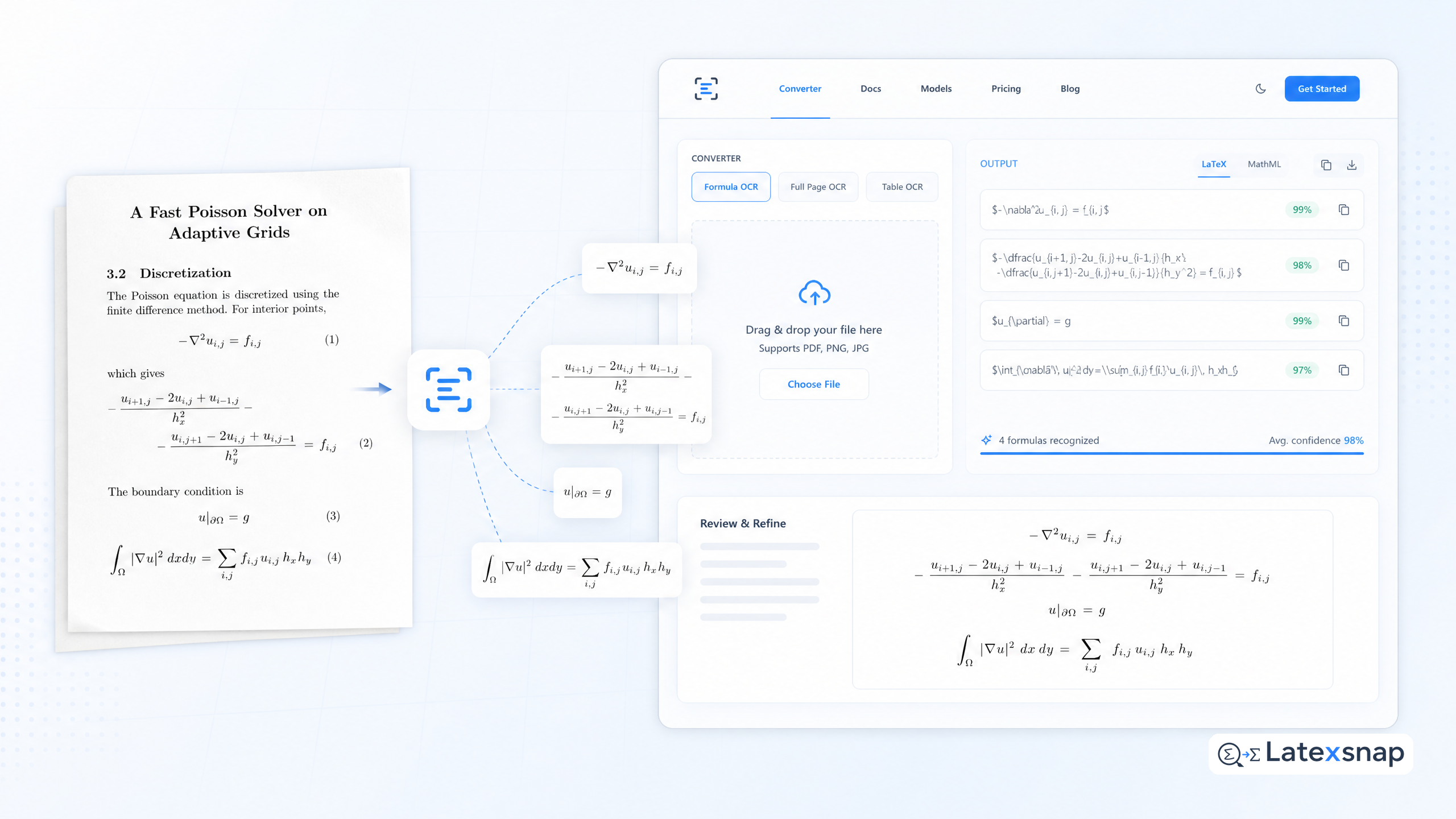
When using Nougat or LatexSnap to convert formulas to LaTeX, it's important to review the output carefully. There are a few things to keep in mind:
Crop quality: The quality of the input image can have a significant impact on the accuracy of the OCR. Make sure that the image is clear and well-cropped.
Ambiguous symbols: Some symbols can be ambiguous, and may be interpreted differently by different OCR engines. Be sure to review the output carefully to make sure that the symbols are correct.
LaTeX structure: The LaTeX code generated by Nougat or LatexSnap may not be perfectly formatted. You may need to make some adjustments to the code to make it compatible with your document.
Manual review: It's always a good idea to review the output manually to make sure that it's accurate and well-formatted. This will help to ensure that the formulas are correct and that the document is professional-looking.
Conclusion
Nougat is a new model for OCR of academic papers, with a focus on formulas. It's a significant improvement over existing OCR engines, and it's a valuable tool for researchers and technical writers.
LatexSnap is a tool for converting equation images, handwriting, screenshots, and PDF formula snippets into editable LaTeX. It's a powerful tool for researchers and technical writers who need to work with formulas in their documents. When the document pipeline gets more complex, How to Keep Citations and LaTeX Equations Organized in Research Notes gives more context on citation and equation notes.
Nougat is an interesting development for LatexSnap, which also focuses on OCR of formulas in academic papers. LatexSnap can be used to convert Nougat output to editable LaTeX, which allows researchers and technical writers to easily incorporate formulas into their documents.
Convert formulas faster
Turn screenshots, handwriting, and PDFs into editable LaTeX.
