DBNet and Cleaner Equation Masks for Faster Formula Capture
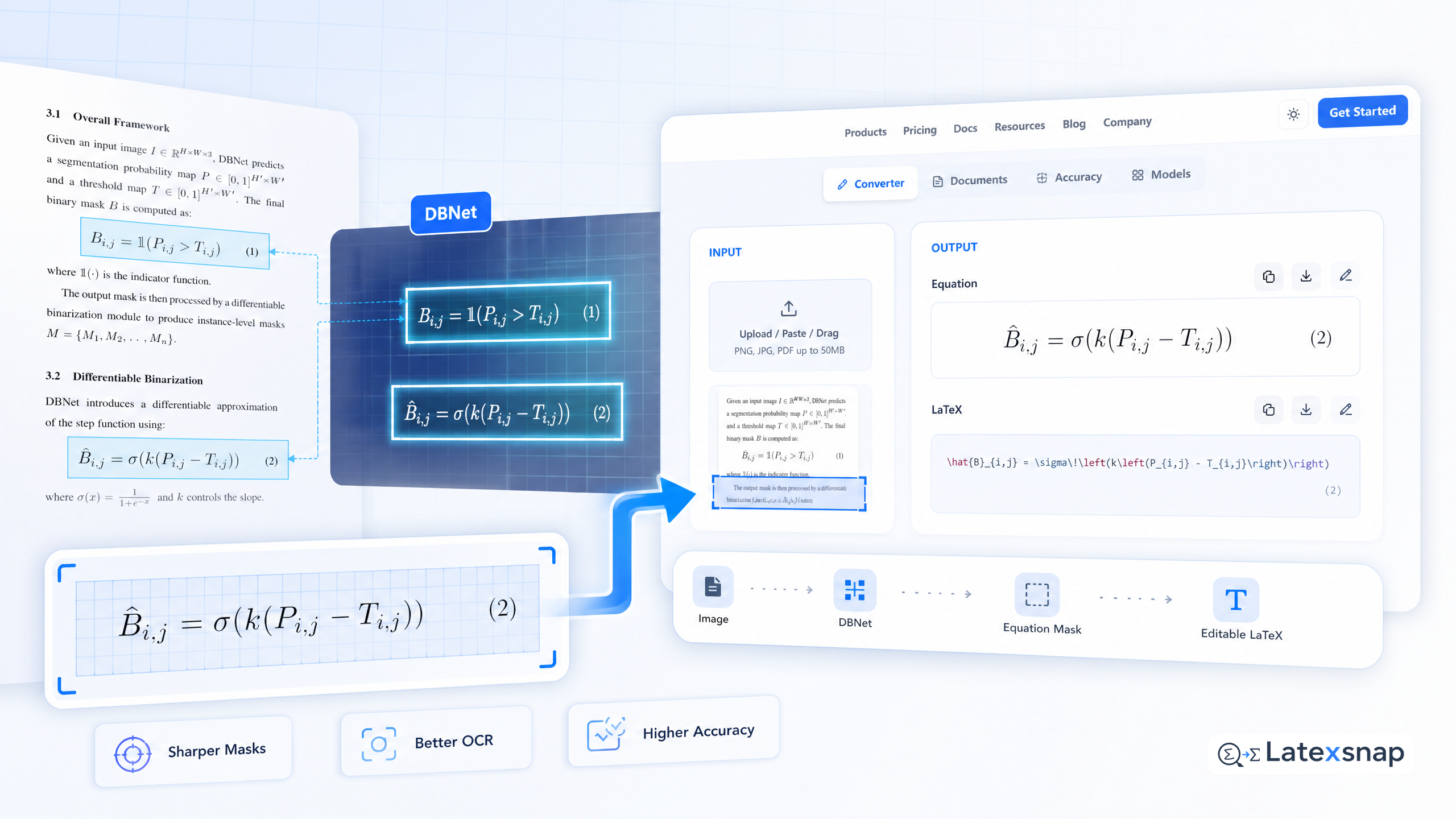
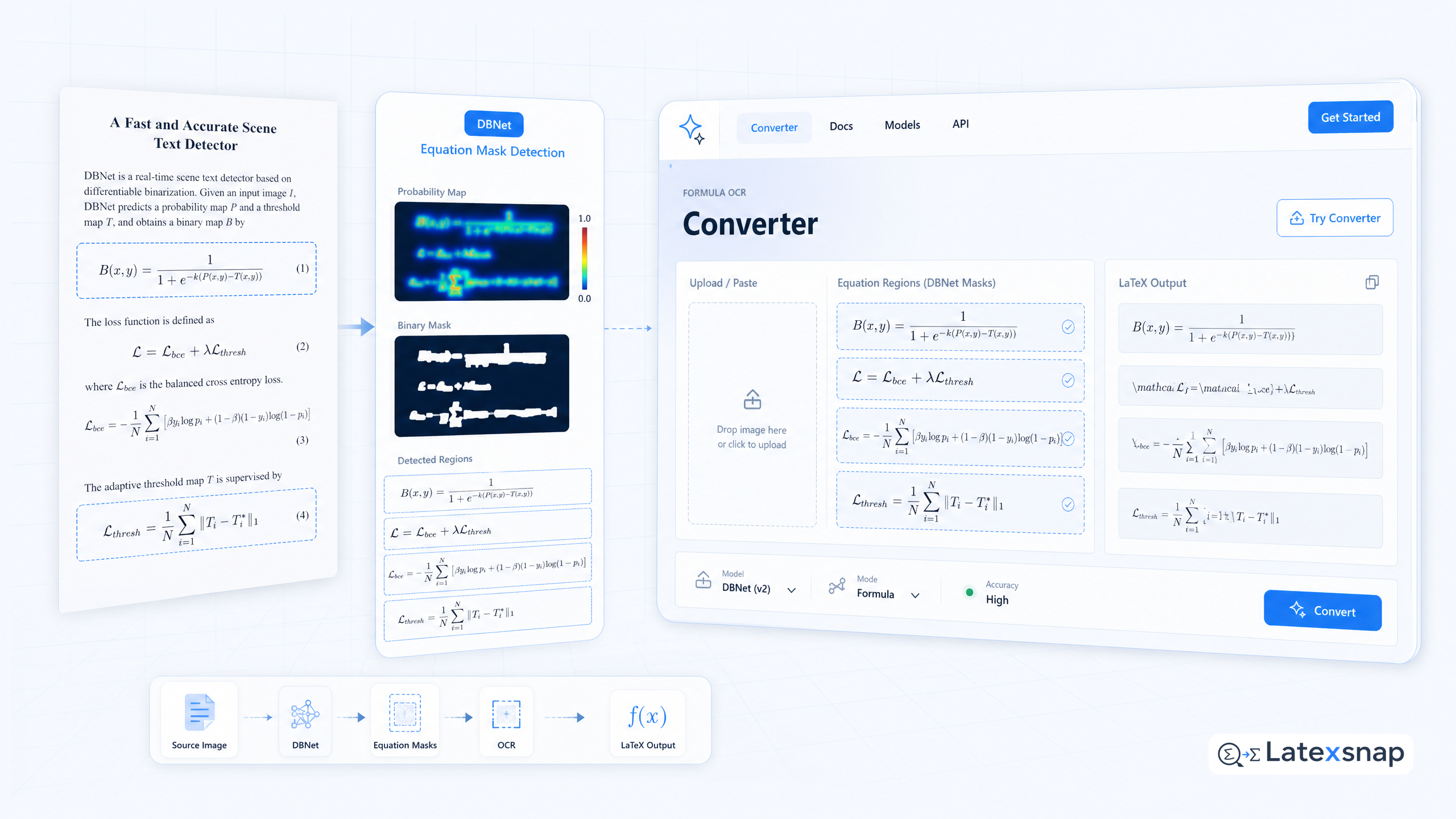
Equation capture is a key capability for LatexSnap. We use equation mask detection to find the regions of interest in images that contain mathematical formulas. This article explains how DBNet improves the quality of equation masks and why that matters for OCR accuracy.
The Problem with Traditional Equation Mask Detection
LatexSnap uses equation mask detection to locate mathematical formulas in images. The goal is to create precise bounding boxes or segmentation masks that outline the formula region. Traditional methods often struggle with: For a related next step on equation region detection, see CTPN and the First Step: Finding Equation Regions Before OCR.
- Inaccurate boundaries around complex formulas
- Poor handling of multi-line equations
- Difficulty with formulas containing special symbols
These issues can lead to incomplete or incorrect formula extraction, which impacts the overall quality of the captured LaTeX.
DBNet: A New Approach to Equation Mask Detection
DBNet (Differentiable Binarization Network) is a recent advancement in scene text detection that has been adapted for equation mask detection. The key innovation is the use of differentiable binarization, which allows for more precise and accurate mask generation. A useful companion workflow is EAST and Better Crop Boundaries for Equation Screenshots, especially when text detection crop boundaries becomes part of the review process.
How DBNet Works
DBNet employs a differentiable binarization function that approximates the traditional non-differentiable binarization process. This approach enables end-to-end training of the network, leading to better convergence and more accurate mask predictions.
The network architecture typically includes:
- A backbone feature extractor (e.g., ResNet)
- A differentiable binarization module
- A prediction head for generating masks
Benefits of DBNet for Equation Capture
The adoption of DBNet in LatexSnap has led to several improvements in equation capture:
1. Improved Mask Accuracy
DBNet produces cleaner and more accurate equation masks. This is crucial for:
- Precise cropping of formula regions
- Better handling of complex mathematical expressions
- Reduced inclusion of irrelevant image content
2. Enhanced OCR Performance
Accurate masks directly impact the performance of the OCR engine. With DBNet:
- The OCR engine receives cleaner input regions
- Character recognition is improved due to reduced noise
- Special symbols and operators are more accurately identified
3. Faster Processing
The differentiable nature of DBNet allows for more efficient training and inference. This translates to:
- Faster equation detection in real-time applications
- Reduced computational resources required
- Improved user experience in formula capture workflows
Practical Implications for LatexSnap Users
For users of LatexSnap, the integration of DBNet means:
Better Formula Extraction
Equations are captured with higher fidelity, preserving the structure and symbols accurately. This is particularly important for:
- Academic papers with complex formulas
- Technical documents with specialized notation
- Educational materials containing mathematical content
Improved Workflow Efficiency
The enhanced mask detection reduces the need for manual intervention in formula capture. Users can expect: If you want to compare this with another practical angle, CRAFT and Character-Level Clues for Math Symbol Localization covers math symbol localization in more detail.
- Fewer corrections needed in the captured LaTeX
- Streamlined workflow for document digitization
- More reliable results across different types of documents
Tips for Optimal Equation Capture
To maximize the benefits of DBNet in LatexSnap, consider the following:
Image Quality
High-quality images yield better mask detection results. Ensure:
- Clear, high-resolution images
- Adequate contrast between text and background
- Minimal distortion or perspective issues
Formula Complexity
While DBNet handles complex formulas well, be aware that:
- Very large or multi-page equations may require additional processing
- Highly stylized or handwritten formulas might need manual review
- Specialized notation may benefit from targeted training
Post-Processing
Even with improved mask detection, some post-processing may be necessary:
- Review and adjust masks for edge cases
- Use LatexSnap's editing tools to refine captured formulas
- Consider combining multiple captures for comprehensive formula extraction
Future Directions
The integration of DBNet in LatexSnap represents a significant step forward in equation capture technology. Future developments may include: When the document pipeline gets more complex, RARE and Automatic Rectification for Crooked Equation Screenshots gives more context on equation image rectification.
- Further refinements to the DBNet architecture for even better performance
- Integration with other advanced AI techniques for holistic document understanding
- Expansion to support additional languages and specialized notations
Conclusion
DBNet and its application to equation mask detection have brought significant improvements to LatexSnap's formula capture capabilities. By providing more accurate and reliable masks, DBNet enhances the overall quality of equation OCR, leading to better LaTeX output and a more efficient user experience.
As LatexSnap continues to evolve, the integration of advanced techniques like DBNet will play a crucial role in maintaining its position as a leading tool for equation capture and LaTeX conversion. For users and developers alike, understanding these advancements provides valuable insights into the ongoing improvements in document digitization and formula recognition technologies. For teams extending this workflow, CTC and the Problem of Reading Unsegmented Formula Images is a natural follow-up for CTC formula OCR.
Convert formulas faster
Turn screenshots, handwriting, and PDFs into editable LaTeX.
