CRAFT and Character-Level Clues for Math Symbol Localization

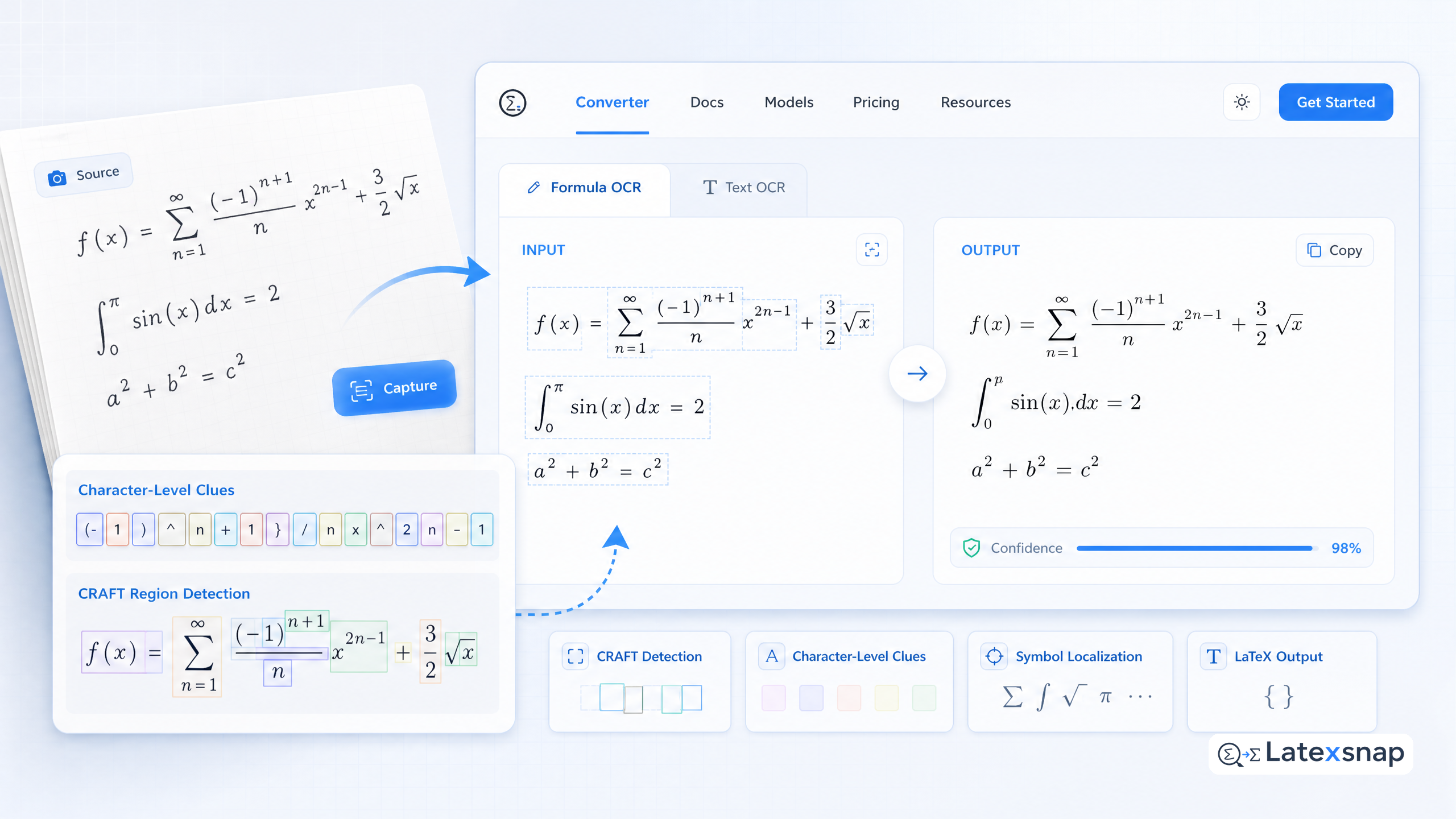
LatexSnap's equation OCR engine excels at converting handwritten and printed formulas into editable LaTeX. It handles complex expressions, multi-line equations, and even math-heavy text passages with high accuracy. However, like any OCR system, it can occasionally miss small symbols or misinterpret ambiguous characters. Understanding how models like CRAFT (Character Region Awareness For Text Detection) approach character-level localization can help users refine their review workflows and improve final output quality. For a related next step on equation region detection, see CTPN and the First Step: Finding Equation Regions Before OCR.
The Challenge of Small Symbols and Operators
Equation OCR systems must identify not only letters and numbers but also mathematical symbols such as integrals, summations, square roots, and operators like , , and . These symbols often appear small, overlapping, or embedded within larger expressions, making them difficult to detect reliably. Missing even a single symbol can break the LaTeX structure or alter the meaning of an equation.
Traditional OCR models often rely on bounding boxes at the word or line level, which can overlook fine-grained details. This is where character-level detection becomes essential. By focusing on individual glyphs and their spatial relationships, models can more accurately localize and transcribe mathematical content.
How CRAFT Works for Character-Level Detection
CRAFT is a deep learning framework designed for text detection in natural scenes. It uses a convolutional neural network to produce two key outputs: a character region score and an affinity score. The region score identifies potential character locations, while the affinity score groups nearby characters into coherent text instances.
In the context of math symbol localization, this approach allows the model to detect individual symbols even when they are part of a dense expression. For example, in an integral sign , CRAFT can distinguish the curve from the differential variable dx beneath it, reducing the risk of merging or omitting components. For teams extending this workflow, MDRNN and Why Two-Dimensional Context Matters in Formula OCR is a natural follow-up for two-dimensional OCR context.
LatexSnap leverages similar character-aware techniques to enhance its equation OCR capabilities. By analyzing glyph shapes, spacing, and contextual patterns, the system can better interpret challenging symbols and maintain structural integrity in the resulting LaTeX. If you want to compare this with another practical angle, EAST and Better Crop Boundaries for Equation Screenshots covers text detection crop boundaries in more detail.
Practical Implications for Equation OCR Workflows
For users reviewing OCR output, understanding character-level detection helps set realistic expectations and guide manual corrections. Here are a few practical tips:
- Inspect small symbols closely: Symbols like , , and may be misread as similar-looking characters. A quick visual check can catch these errors before finalizing the LaTeX.
- Review ambiguous characters: Characters like l (script l), 1 (one), and I (uppercase i) often appear in math contexts. Ensuring the correct glyph is selected improves readability and accuracy.
- Check spacing and alignment: Proper LaTeX formatting depends on correct symbol placement. Misaligned or missing symbols can disrupt equation rendering.
- Use high-quality input images: Clear, well-lit scans or screenshots improve detection accuracy, especially for small or faint symbols.
LatexSnap's Approach to Math Symbol Localization
LatexSnap integrates advanced character-level analysis into its equation OCR pipeline. By combining deep learning models with rule-based validation, the system can identify and transcribe mathematical symbols with high precision. This hybrid approach ensures that even complex expressions are rendered accurately in LaTeX.
The system also supports iterative refinement. Users can flag uncertain regions for reprocessing or manual correction, allowing for continuous improvement of OCR results over time. This flexibility is especially valuable in academic and technical workflows where precision is paramount.
Final Thoughts on Math Symbol Localization
Character-level detection is a critical component of modern equation OCR systems. Models like CRAFT demonstrate how focusing on individual glyphs can significantly improve localization accuracy, especially for small or ambiguous symbols. For LatexSnap users, this means higher-quality LaTeX output and fewer manual corrections. A useful companion workflow is DBNet and Cleaner Equation Masks for Faster Formula Capture, especially when equation mask detection becomes part of the review process.
By understanding the strengths and limitations of character-aware OCR, users can optimize their review processes and achieve more reliable results. Whether you're transcribing handwritten notes, digitizing textbooks, or processing research papers, precise symbol detection is key to maintaining the integrity of mathematical content.
LatexSnap continues to refine its equation OCR capabilities, incorporating insights from research like CRAFT to deliver even better performance. As OCR technology evolves, so too will the tools available to researchers, educators, and technical writers who rely on accurate formula transcription. When the document pipeline gets more complex, Writing LaTeX Math Equations with AI gives more context on formula OCR workflow.
Convert formulas faster
Turn screenshots, handwriting, and PDFs into editable LaTeX.
