EAST and Better Crop Boundaries for Equation Screenshots

Introduction
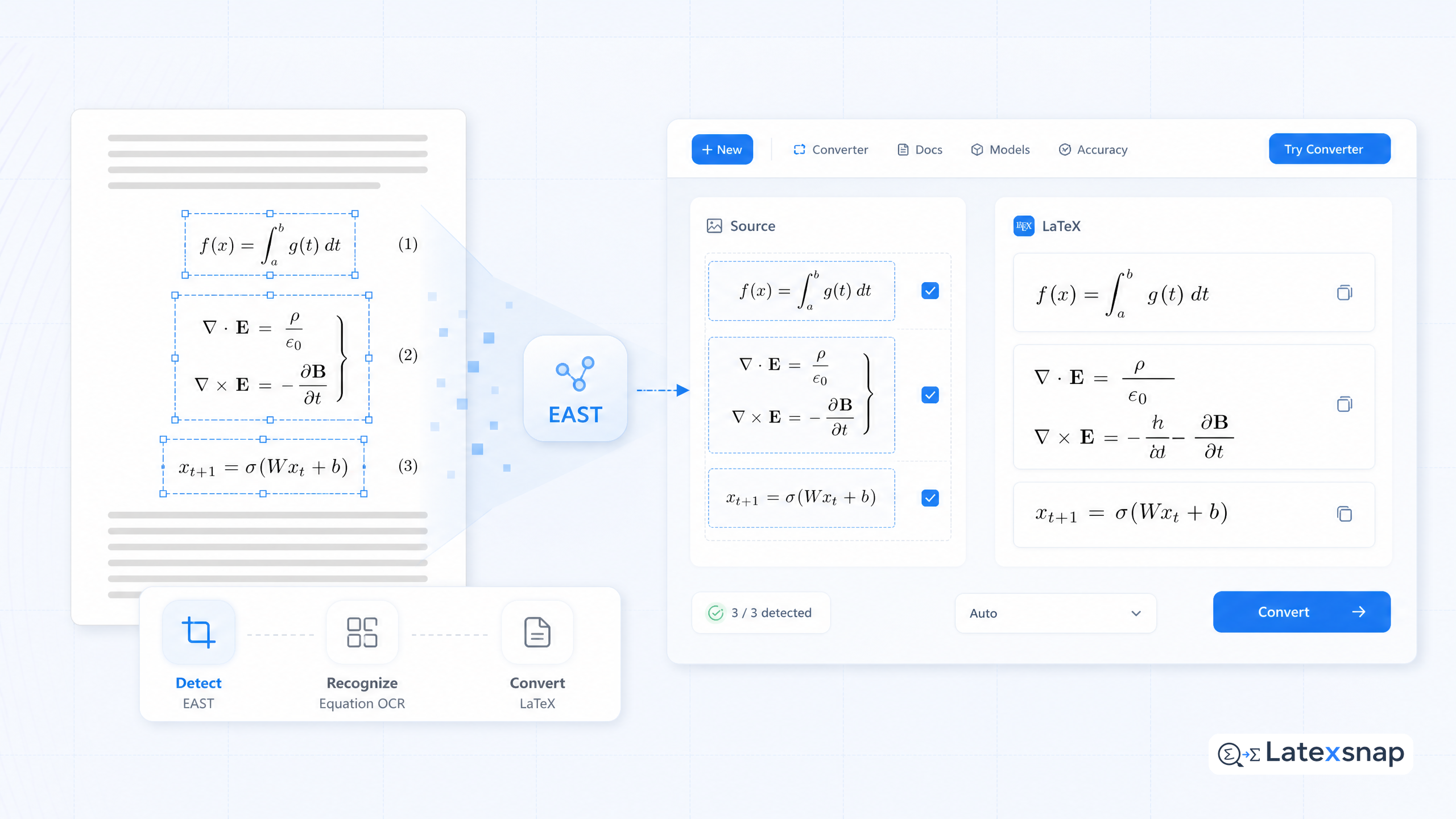
Equation OCR is a specialized subfield of optical character recognition focused on extracting mathematical expressions from images. Unlike standard text recognition, equation OCR must handle complex symbols, multi-line structures, and precise spatial relationships between components. The quality of equation OCR systems depends heavily on accurate text detection and boundary determination.
LatexSnap provides equation image-to-LaTeX conversion for researchers, technical writers, and document builders. Our system processes screenshots, handwritten formulas, PDF snippets, and other equation images into editable LaTeX code. The accuracy of this conversion depends on several factors, with text detection and crop boundaries being particularly important.
The Importance of Text Detection
Text detection serves as the foundation for equation OCR systems. The detection process identifies where text appears in an image and determines the boundaries of text regions. For equation OCR, this step is critical because: For a related next step on equation region detection, see CTPN and the First Step: Finding Equation Regions Before OCR.
- It determines which parts of an image contain mathematical content
- It establishes the spatial relationships between different equation components
- It influences the quality of subsequent OCR processing
Poor text detection can lead to missed equations, incomplete symbol recognition, or incorrect structural interpretation. The detection algorithm must accurately identify text regions while distinguishing them from non-text elements like graphical components or decorative elements.
EAST: A Breakthrough in Text Detection
The EAST (Efficient and Accurate Scene Text Detector) framework represents a significant advancement in text detection technology. Developed by researchers at Megvii Technology, EAST introduced a unified approach to multi-oriented text detection that achieved remarkable accuracy and efficiency.
The EAST framework operates through several key mechanisms:
- Multi-channel prediction: The system uses multiple prediction channels to detect text in various orientations simultaneously
- Holistic region representation: Instead of detecting individual characters, EAST identifies complete text regions as unified entities
- Differentiable binarization: This technique allows the model to learn optimal text region boundaries through gradient-based optimization
The EAST architecture demonstrates superior performance across diverse text scenarios, including curved text, multi-line equations, and text with varying orientations. Its efficiency makes it suitable for real-time applications, while its accuracy ensures reliable detection even in challenging conditions.
Impact on Equation OCR Quality
The choice of text detection algorithm significantly affects equation OCR performance. When EAST is employed as the detection backbone, several improvements become apparent: A useful companion workflow is DBNet and Cleaner Equation Masks for Faster Formula Capture, especially when equation mask detection becomes part of the review process.
Improved Crop Boundaries
EAST's multi-channel prediction approach produces more accurate text region boundaries. For equation OCR, this means:
- More complete capture of equation components
- Reduced inclusion of irrelevant background elements
- Better preservation of spatial relationships between symbols
The accuracy of crop boundaries directly influences the quality of subsequent OCR processing. When equations are properly bounded, the OCR engine can focus computational resources on the relevant content rather than attempting to process extraneous elements.
Enhanced Symbol Recognition
Accurate text detection enables better symbol recognition through several mechanisms: If you want to compare this with another practical angle, CRAFT and Character-Level Clues for Math Symbol Localization covers math symbol localization in more detail.
- Contextual awareness: Properly bounded text regions provide better contextual information for symbol classification
- Reduced noise: Cleaner input images lead to more confident symbol predictions
- Structural preservation: Maintaining the spatial relationships between symbols helps the OCR engine understand equation structure
For complex mathematical expressions, these improvements are particularly valuable. Equations often contain specialized symbols that require careful contextual analysis for accurate recognition.
Structural Interpretation Benefits
The structural integrity of detected equations affects how well the OCR system can interpret mathematical relationships:
- Component grouping: Accurate detection helps group related symbols together
- Operator placement: Proper boundaries ensure operators are correctly associated with their operands
- Line continuation: Multi-line equations are more reliably detected as continuous structures
These structural benefits translate directly into higher-quality LaTeX output, with fewer errors in symbol placement and relationship representation.
Practical Considerations for Equation OCR
When evaluating equation OCR systems, several practical factors should be considered:
Detection Accuracy vs. Processing Speed
There's often a trade-off between detection accuracy and processing speed. While EAST offers excellent accuracy, some applications may prioritize speed over perfect detection. The optimal balance depends on the specific use case:
- Research applications: May prioritize accuracy over speed
- Real-time processing: May need to balance both factors
- Batch processing: Can often afford slower, more accurate detection
Handling Ambiguous Cases
Equation OCR systems must handle various challenging scenarios:
- Partial equations: Incomplete or cut-off mathematical expressions
- Handwritten formulas: Variable handwriting styles and quality
- Complex layouts: Equations with multiple columns or nested structures
- Low-quality images: Blurry or poorly lit equation images
Robust systems should provide clear feedback when detection confidence is low, allowing users to review and correct problematic areas.
Integration with Downstream Processing
The quality of text detection affects all subsequent processing stages:
- OCR accuracy: Better detection leads to more accurate character recognition
- LaTeX generation: Proper structure detection enables better LaTeX formatting
- Error correction: Clear boundaries make manual review and correction more efficient
Systems that integrate well with downstream processing can provide end-to-end solutions that handle the entire equation-to-LaTeX pipeline effectively. For teams extending this workflow, RARE and Automatic Rectification for Crooked Equation Screenshots is a natural follow-up for equation image rectification.
Recommendations for Equation OCR Review
When reviewing equation OCR systems, consider these practical guidelines:
Evaluate Crop Quality
Assess the quality of detected text regions by examining:
- Boundary accuracy around equation components
- Inclusion of relevant symbols and operators
- Exclusion of irrelevant background elements
- Preservation of spatial relationships
High-quality crops should contain complete equation components while minimizing extraneous content.
Check Symbol Recognition Accuracy
Verify that the system correctly recognizes:
- Specialized mathematical symbols
- Operators and their proper placement
- Multi-character symbols and subscripts/superscripts
- Complex notation like integrals, summations, and fractions
Pay particular attention to symbols that are commonly confused or have similar visual characteristics.
Assess LaTeX Structure Quality
Evaluate the generated LaTeX output for:
- Correct symbol representation
- Proper structural formatting
- Appropriate use of LaTeX commands
- Consistency with standard mathematical notation
The LaTeX output should be both accurate and easily editable.
Perform Manual Review
Even the best equation OCR systems benefit from manual review. Consider:
- Spot-checking randomly selected equations
- Verifying complex or ambiguous cases
- Testing edge cases and unusual formats
- Assessing the system's handling of errors
Manual review provides valuable insights into system strengths and weaknesses that automated metrics might miss.
Conclusion
Text detection and crop boundary quality are fundamental to equation OCR performance. The EAST framework represents a significant advancement in this area, offering improved accuracy and efficiency for detecting mathematical expressions. When evaluating equation OCR systems, it's essential to consider how detection quality affects downstream processing and final output quality.
For researchers, technical writers, and document builders working with mathematical content, choosing an equation OCR system with robust text detection capabilities can significantly improve workflow efficiency and output quality. Systems that combine accurate detection with reliable OCR processing provide the best foundation for converting equation images into editable LaTeX code. When the document pipeline gets more complex, CTC and the Problem of Reading Unsegmented Formula Images gives more context on CTC formula OCR.
As equation OCR technology continues to evolve, the importance of high-quality text detection will only increase. Future systems will likely build upon frameworks like EAST to achieve even greater accuracy and efficiency in handling the complex task of mathematical expression recognition.
Convert formulas faster
Turn screenshots, handwriting, and PDFs into editable LaTeX.
