CRNN Lessons for Turning Image Features into LaTeX Tokens
From Pixels to Sequences
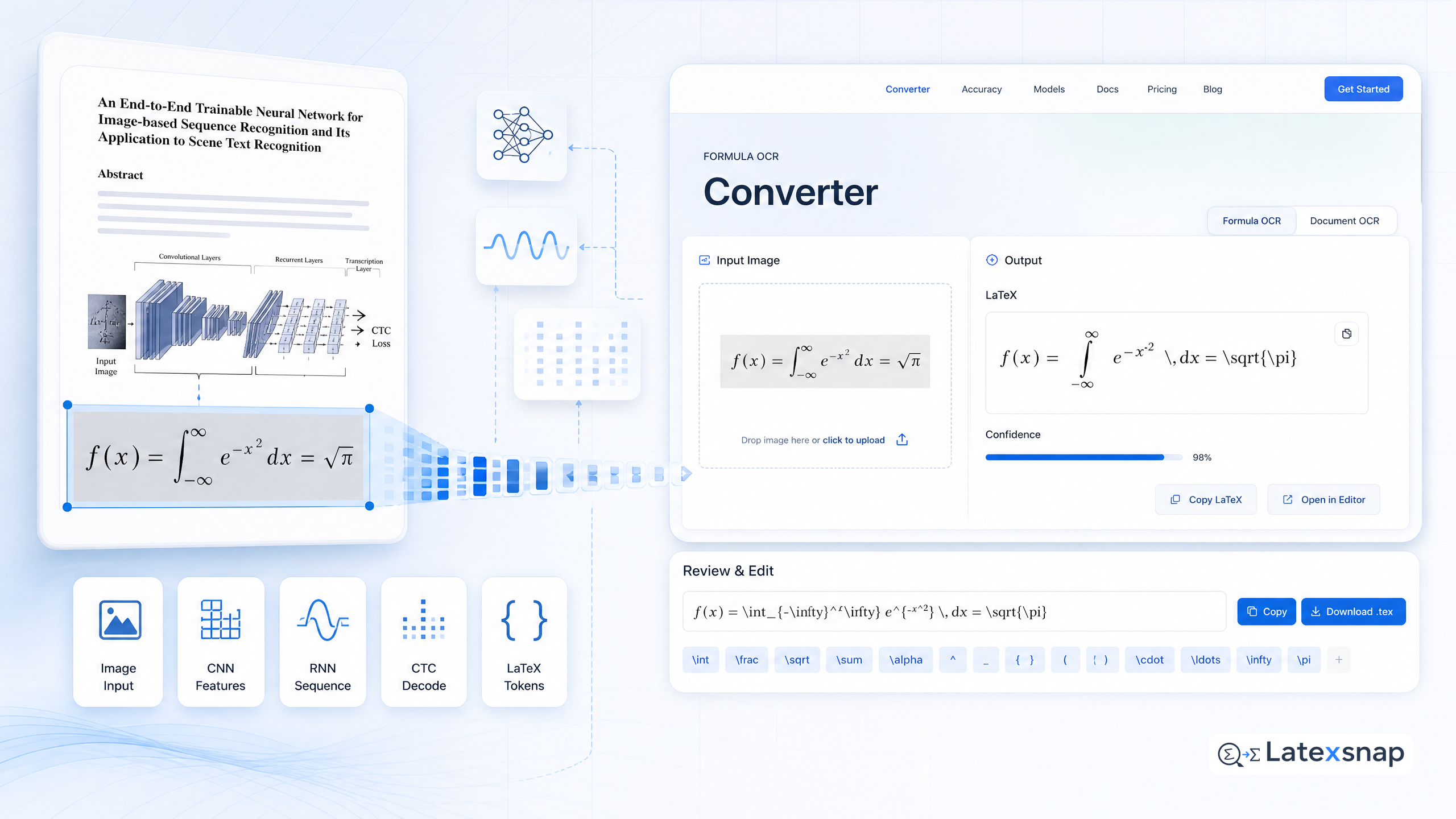
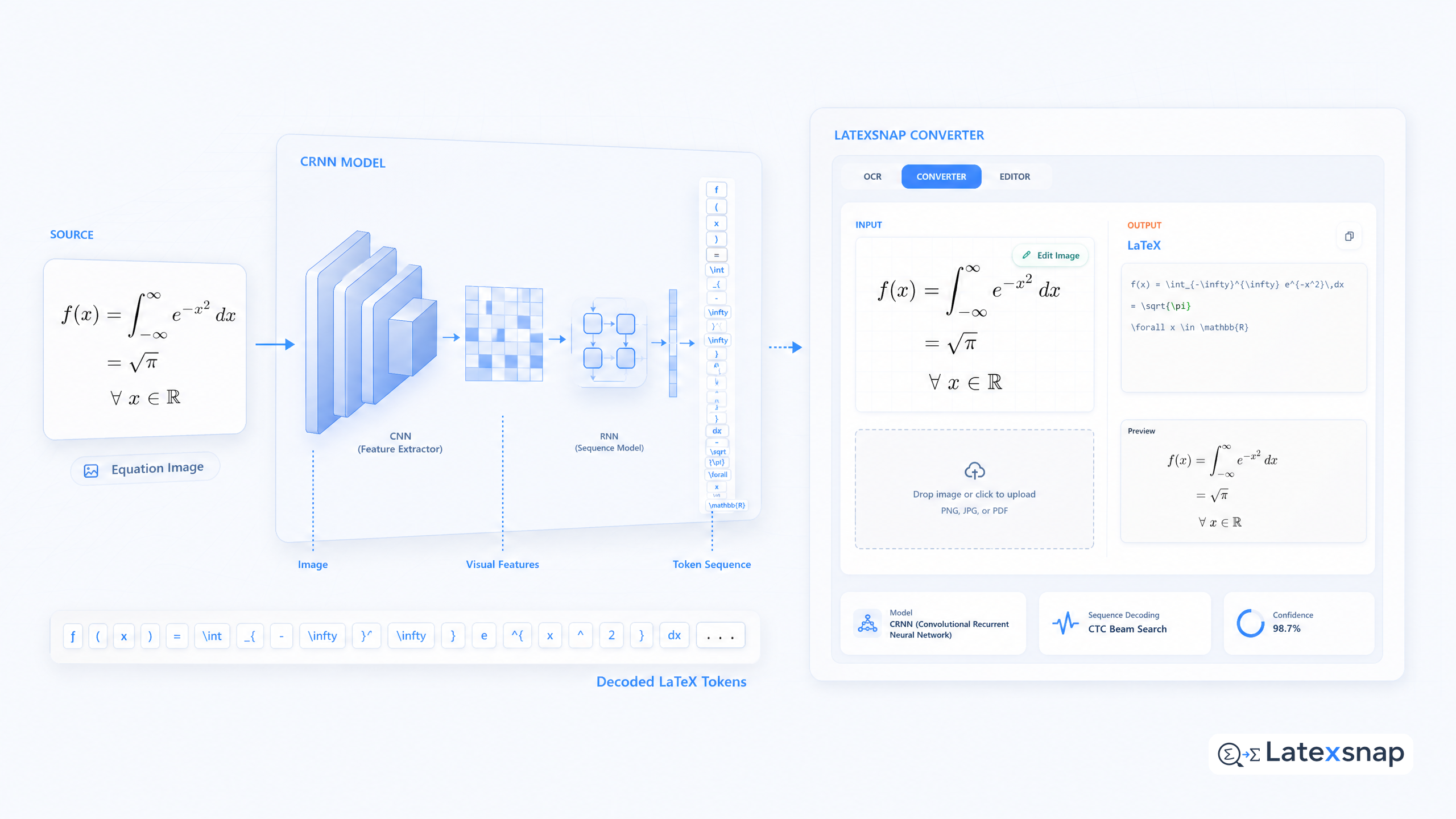
When we built LatexSnap's equation OCR, we needed a way to turn raw image pixels into structured LaTeX tokens. The CRNN paper offered a clean blueprint: treat the image as a sequence of visual features, then decode those features into a string of tokens. In practice, that means feeding an image through a convolutional encoder, extracting a feature map, and running a recurrent decoder that emits one LaTeX symbol at a time. The result is a model that learns both local patterns (like "") and global context (like how an integral sign relates to its integrand).
Convolutional Encoders for Formula Regions
The CRNN approach starts with a convolutional encoder that compresses an image into a grid of feature vectors. For equations, we crop the region of interest and resize it to a fixed width, then pass it through a CNN. Each cell in the resulting feature map captures local structure-think of it as a high-resolution sketch of the formula. This step is crucial for LatexSnap because it lets us handle variable fonts, slanted handwriting, and low-resolution scans without losing detail. A useful companion workflow is TrOCR and Transformer-Based Reading for Image-to-LaTeX Workflows, especially when transformer OCR becomes part of the review process.
Recurrent Decoders for Token-by-Token Output
Once the encoder produces a feature map, the CRNN model uses a recurrent decoder to emit tokens one at a time. Each step takes the current feature vector and the previous token, then predicts the next LaTeX symbol. This design is powerful for equations because it allows the model to correct early mistakes using later context. For example, if the decoder initially misreads a "d" as a "b," seeing a nearby integral sign can help it revise the decision. In LatexSnap, this mechanism improves robustness across diverse handwriting styles and degraded scans.
Training with Sequence Labels
CRNN trains directly from image-to-sequence pairs, which means we can label equations with their full LaTeX strings and let the model learn the mapping end-to-end. No intermediate segmentation or symbol-level annotations are required. For LatexSnap, this simplifies data preparation: we collect cropped equation images and their corresponding LaTeX, then train the model to predict the sequence. The result is a system that generalizes well to new domains, such as math textbooks or research papers. If you want to compare this with another practical angle, Image to LaTeX workflow covers formula OCR workflow in more detail.
Practical Takeaways for Equation OCR
If you're building or evaluating an equation OCR system, CRNN offers several lessons. First, always crop and normalize the input region to reduce noise and variation. Second, use a recurrent decoder to capture long-range dependencies between symbols. Third, train with full LaTeX sequences rather than isolated symbols to preserve structural relationships. Finally, include manual review steps for ambiguous cases, such as overlapping integrals or handwritten fractions. For teams extending this workflow, CTPN and the First Step: Finding Equation Regions Before OCR is a natural follow-up for equation region detection.
Integrating CRNN into LatexSnap
LatexSnap applies these principles by combining a convolutional encoder with a recurrent decoder tailored for LaTeX tokens. The system handles both printed and handwritten equations, supports multiple languages, and integrates seamlessly with document workflows. Users can upload images or PDFs, receive editable LaTeX output, and continue working in their preferred editor. This end-to-end pipeline reduces friction between capturing equations and using them in documents. When the document pipeline gets more complex, Best LaTeX Table Generators: Features and Performance Review gives more context on document OCR workflow.
Final Thoughts
The CRNN paper demonstrates that sequence recognition models can be both simple and powerful. For equation OCR, the key is balancing local feature extraction with global context modeling. LatexSnap leverages this approach to deliver accurate, editable LaTeX from images. Whether you're digitizing textbooks, transcribing research notes, or automating document workflows, the CRNN framework provides a solid foundation for turning visual formulas into usable text. For a related next step on CTC formula OCR, see CTC and the Problem of Reading Unsegmented Formula Images.
Convert formulas faster
Turn screenshots, handwriting, and PDFs into editable LaTeX.
